
UPPING THE ANTE!
Lifestyle shifts cropped up and imaginations quietly soared. A jim-dandy design phenomenon continued its launch onto the Paris purview. From the ground up a new group of visionary decorators proceeded to showcase and debut standout interiors. (Much of the decor of the thirties almost seemed shocking representing a summit of streamlined and functional interiors. No art, no bibelots, no table accents. It epitomized a time that defined that bleak hopeless period of the Depression and became an agent for simplicity or minimalism using subtle varieties of handsome surfaces.)
PART TWO:
The design drama of MINIMALISM and MODERNISM UNFURLED!
But firstly, there is an underlying story of a family of German Nationals who were put under house arrest while living in Paris. Leon Frank was a prominent wealthy Jewish banker who married his own niece, Nanette, and the couple had three sons. All their assets were seized by the Germans when they invaded France in the First World War. The two oldest sons became French soldiers and within two weeks of each other each boy was killed in action. Beside the tragic loss of his sons, Leon’s deep despair was equally reinforced by the realization that possibly his inherent sons were killing their personal relatives, members of their own family!
Leon committed suicide by jumping out of the window of their apartment.
It was the third, and youngest son, Jean-Michel whose unique Minimalist style of decorating would explode upon the Parisienne decorating landscape.


His first pursuit as a student was the study of law but an early profound interest in art and literature would be reshaped into decorating. It was said his work offered a sense of mystery and poetry. His ability to avoid any unnecessary decoration or ornament still left the room with a feeling of the greatest luxury because “his rooms were settings for people, not for paintings or sculptures or art but there was a richness of surface of gold lacquer, snakeskin, parchment, straw marquetry” …Battersby
He formed a partnership with Adolphe Chanaux and together, they opened a shop.

His atelier became a locale where the kindred spirits of Diego and Alberto Giacometti, Christian Berard, and Emilio Terry influenced and worked as teams at times. This group would fulfill commissions together or each would work solely to outstanding achievements.

Their sophisticated design interpretations were in demand on both sides of the Atlantic. JEAN-MICHEL FRANK was considered to be one of the greatest decorators of the Twentieth Century. Frank used imaginative textures, simple geometry, and understated luxury. He had meticulous craftsman creating his design compositions and blended vellum, lacquer, ivory, suede, calfskin, and morocco.
The Story of Parchment: In my mind, parchment is the original writing tablet, but I cannot take it with me or buy it in stores. It is not made from wood pulp, it is not even close to a paper product. Nope and nada! Parchment is made from animal skin. Sheep, calves, and goat skin is scraped, dried, and stretched to be used for writing material.

The art patrons Vicomte and Vicomtesse de Noialles commissioned Frank to decorate two rooms in their salon. The de Noialles’ rooms were to be the most important of his career befitting a trendsetting and cutting-edge decorating scheme.
Jean-Michel often used parchment as a preferred decorating style.
He featured it as a wall-covering at the de Noialles salon by having craftsmen adhere large squares of parchment to completely cover high walls and ceilings that had been stripped of all moldings. Furniture in white leather, low shagreen tables while bronze lamps contrasted with straw marquetry crystal and ivory. The facade of the fireplace had mica tiles applied in a brick pattern completing the salon design.

The de Noialles dining room highlighted furniture of macassar ebony, a dense hardwood of black stripes over yellowish or reddish brown colors.

Vellum covered the walls of the Noailles dining room’s showcasing macassar ebony furniture with a Modernist carpet on parquet.

Frank’s rooms were purposely left bare and boxlike. He preferred not to hang pictures and used sparsely placed Greek fragments as the sole decorating accents
This sudden and unexpectedly brusque form of decorating was bound to bring humoresque comments. Two making the rounds at that time were: When the multi-talented French poet Jean Cocteau saw the de Noialles rooms, he said, “They look as though they have been robbed!”
The second famous off-repeated joke had a guest entering an apartment through a foyer that was completely empty and going through two more empty rooms to then enter a dining room that held only a table and two chairs. The hostess was sitting on one of the chairs staring at the plain table that held only the sculpture of a nose. At the surprised look of her guest, the hostess reverently said, “Ah, but the nose is from Alexandria,” finishing the joke.
The de Noialles were devoted art patrons and eventually began to hang paintings and add art to Frank’s pristine design, and a rift was born between client and designer.

Another method used by Jean-Michel was the style of straw-marquetry. He showcased the process lavishly in his interior decorating.
The Story of Straw-Marquetry: It was a time-consuming method of slicing open blades of rye or oat straw, soaking the straw in hot or cold water and then ironing the straw flat and adhering the flattened straw into various styles and patterns. It is the process of turning humble pieces of straw into dazzling and sumptuous facades.
The Salon of Jean-Michel Frank was designed employing straw-marquetry on his walls offering a soft golden glow to his salon.

Cabinet of Straw -Marquetry in fan shape design.

Rich textures applied throughout the Frank Bedroom: Mirror and screen of straw-marquetry, coffee table of wood and mica.

Equally favored by Frank was the technique of using shagreen on his signature furniture designs.
The Story of Shagreen: Shagreen is an untanned leather that is covered with small round granulations. It is the rough skin of various sharks and rays covered with small close-set tubercles. It is usually dyed green. Frank had his shagreen (sharkskin )sanded for a smoother finish.
The haute-couture dress designer Elsa Schiaparelli whom we met in Minimalism Part One of the Shocking Pink fame entrusted Jean-Michel Frank to decorate her perfume boutique. He turned it into a gilded bamboo cage featuring her new perfume scent “Shocking.” It is a giant aviary of black metal with painted flowers attached randomly to the the poles. Display cases highlight her panoply of perfumes. Frank’s and Elsa’s Birdcage salon was a resounding success.

Frank decorated not only the Schiaparelli Perfume Salon but also her boutique, homes, and her first perfume bottle, “Salut.”

most surprisingly, he began to add colors to his decor. Below in the Salon of Schiaparelli, Frank used curtains of a shimmering rubberized fabric accented with an orange and yellow leather sofa amid paneled walls with chintz accents.

He continued to create decorating milestones with his partner Adolphe Channaux forming a cultural hub of elegant furniture repertoire and lighting fixtures of terracotta, gypsum, and ivory.

Vases, lamps, and small tables and stools were inspired by Cubist, Chinese, and Egyptian styles. 
Vibrations of harms way were working their way to Paris with the sound of Nazi boots on the ground.
Jean-Michel took his esthetic talents to Argentina where here once again he fulfilled his eminent reputation with numerous decorating contracts and commissions. An Iron and Leather settee designed in 1937, still in circulation today.

But he did not stay, he emigrated to New York, brilliantly designing the Rockefeller apartment with bold dramatic colors and eye-catching interiors. As usual, he incorporated art and furniture by the other decorators in his continuing decorating circle.


And instead of gathering speed for a continuation of more creative vision such as the Templeton Crocker San Francisco commission… there was to be an absence that would soon overtake the decorating world. Jean-Michel’s is lifelong melancholy was ripping him apart. The evocative change-maker, Jean-Michel Frank, Decorator committed suicide at age 46. Speaking from his heart and soul, he said, “I do this for no reason but ill health. I ask all my friends who have been so good to me to forgive me. I thank them deeply for trying to help me, but I have no strength to go on. I am too ill.”
(His personal possessions were left in his apartment in Buenos Aires.)
The Parsons table was designed by Jean-Michel Frank while he was working at Parsons Paris——a design school in Paris and an equally famous partner Parsons School in New York City.
Parsons tables are often intended for use as modern or contemporary furniture, and their striking design has made them popular as coffee tables, dining tables, side tables, and occasional tables. Less-expensive versions are also available, which can be easily stacked, disassembled, and reassembled. Most are typically made of wood, metal, or plastic, and they are frequently employed in interior furnishings as well as patio and even lawn furniture.

Jean-Michel Frank was a first-cousin, once removed, to the young diarist Anne Frank although they never met. His works are highly sought after by leading collectors worldwide. Many of the premier auction houses offer his pieces, and prices are often in excess of 200,000 Euros.

Sy’s Salient Points:
Straw-marquetry was resuscitated in the mid-1970’s by one young woman in Paris. Lison de Caunes, whose grandfather, a premier Art Deco designer used straw-marquetry in his furnishings and bequeathed bags of straw to her from his collections.
Lison de Caunes
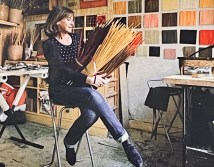
(Caunes said, “I love that you can create things so incredibly refined and luxurious from such humble material.” It has been her life work for over 40 years.)
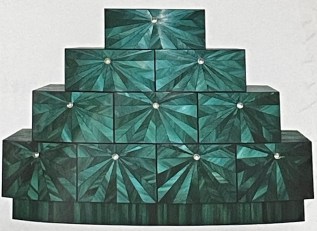
Architectural Digest November 2015
Research From: Lectures by Sheila Yates ASID New York Javitts Hall, slides from her collection and various internet sites.
Happy Summer Holiday, Darling Blaire